
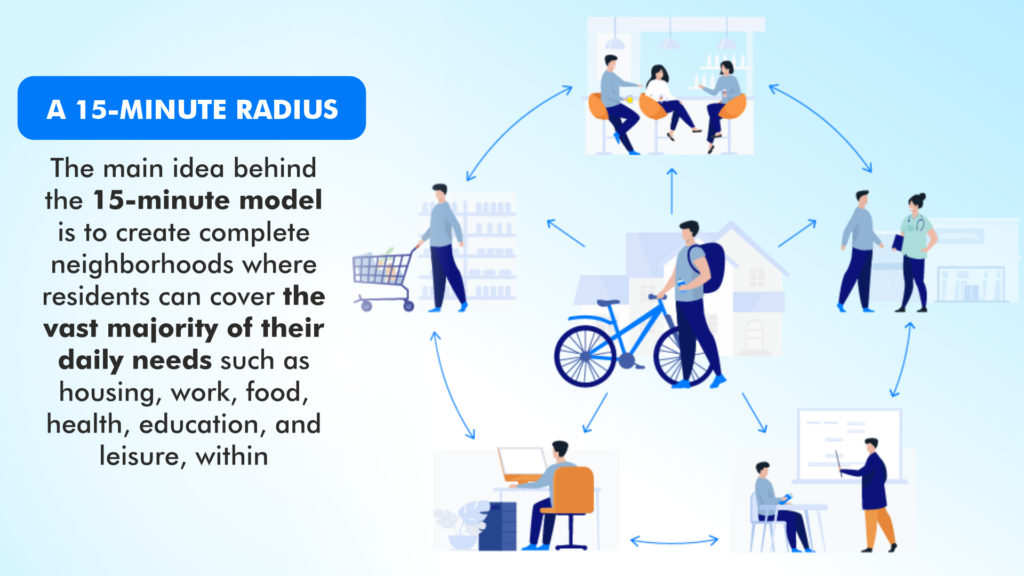
The 15-minute city is an urban planning concept that is increasingly reshaping how people live, work, and interact in modern cities. It envisions neighbourhoods where essential daily needs—such as groceries, healthcare, education, workplaces, parks, and leisure spaces—are accessible within a 15-minute walk or bike ride from home. By promoting compact, mixed-use development, this model challenges car-dependent urban sprawl and prioritises accessibility, convenience, and quality of life.
A major way 15-minute cities are shaping urban life is through their contribution to environmental sustainability. Shorter travel distances reduce dependence on private vehicles, helping to cut traffic congestion, lower carbon emissions, and improve air quality. Encouraging walking and cycling also supports healthier lifestyles, reduces noise pollution, and aligns cities with global climate and sustainability goals, making urban growth more responsible and future-oriented.
Beyond environmental gains, the concept significantly influences social and community life. Walkable neighbourhoods foster stronger social connections by encouraging frequent, informal interactions among residents. Public spaces, local markets, and pedestrian-friendly streets enhance safety and inclusivity while nurturing a sense of belonging. Importantly, the 15-minute city aligns with post-pandemic urban priorities, where resilience, inclusivity, and local self-sufficiency have become critical. By decentralising economic and social activities, cities can better withstand future disruptions while ensuring development remains people-centred rather than infrastructure-driven.
However, the model also faces practical and social challenges. Critics highlight that without equitable planning, 15-minute cities may contribute to gentrification, increasing property values and displacing lower-income residents. Others argue that spatial proximity alone does not automatically change travel behaviour or address deeper inequalities related to housing, employment, and public services. Effective implementation therefore requires inclusive policies, affordable housing strategies, and strong public engagement.
Despite these concerns, the 15-minute city continues to influence urban policy worldwide by redefining how cities measure success. Rather than focusing solely on expansion and mobility speed, it emphasises proximity, liveability, and human-centred design. As cities grow and adapt to climate, health, and social challenges, the 15-minute city offers a compelling framework for building greener, healthier, and more connected urban futures.
SOURCES:
- https://blogs.worldbank.org/en/transport/the-15-minute-city
- https://www.ube.ac.uk/whats-happening/articles/15-minute-city/
- https://www.weforum.org/stories/2021/11/15minute-city-falls-short/
- https://www.deloitte.com/an/en/Industries/government-public/perspectives/urban-future-with-a-purpose/15-minute-city.html