
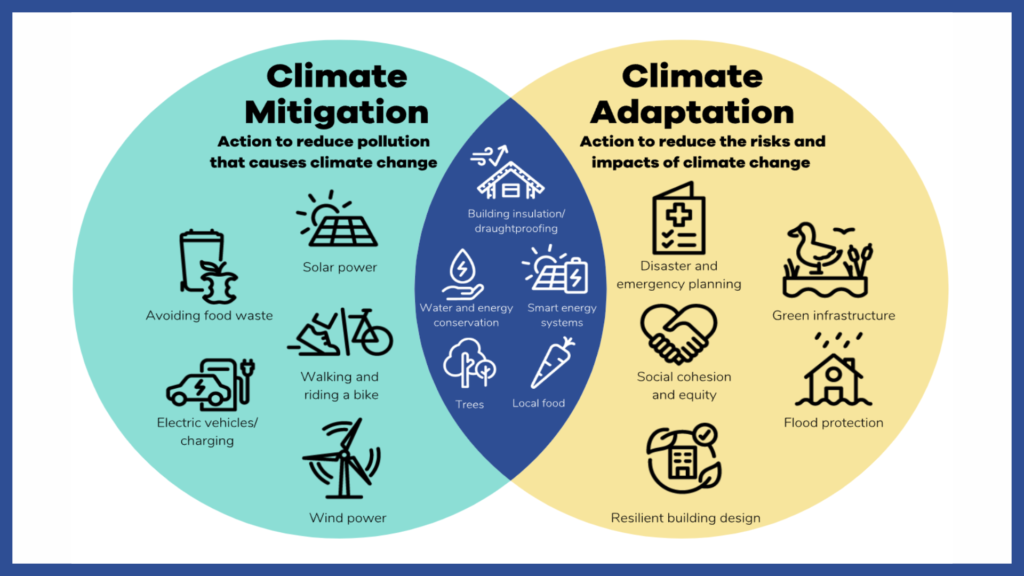
Climate discussions have long focused on mitigation—reducing emissions, transitioning to renewable energy, and slowing the pace of global warming. These efforts remain essential, but the conversation is evolving. As climate impacts become more visible, attention is increasingly turning toward adaptation—the work of preparing societies to live with change, not only preventing it.
This shift reflects a growing awareness that climate change is already shaping everyday life. Rising temperatures, stronger storms, and shifting rainfall patterns are no longer distant projections. Communities across continents are confronting disruptions to housing, water systems, agriculture, and public health. Adaptation emerges in response to this lived reality.
Unlike mitigation, which often operates through long-term global agreements and energy transitions, adaptation feels grounded and immediate. It appears in redesigned infrastructure, flood-resilient neighborhoods, drought-tolerant crops, and early warning systems. These actions offer visible protection, reinforcing the idea that climate policy is not only about the future but also about safeguarding the present.
Economic thinking is reinforcing this direction. Businesses and governments increasingly recognize that resilience protects investments and reduces financial losses. Planning for climate risks is becoming part of mainstream development strategies, influencing decisions about transport networks, housing expansion, and urban growth. Adaptation is gradually integrating into the fabric of economic planning.
Public perception plays a role as well. Mitigation can seem abstract, tied to emission targets and global negotiations. Adaptation, by contrast, is tangible. When communities see stronger drainage systems or shaded urban spaces, climate action becomes something they can observe and experience directly.
In India, this emphasis is particularly pronounced. Intensifying heatwaves, variable monsoons, and water stress are influencing city planning and agricultural practices. Investments in climate-resilient infrastructure and climate-smart farming reflect an effort to protect livelihoods while continuing the transition toward lower emissions.
The growing focus on adaptation does not signal retreat from mitigation. Instead, it reflects a broader understanding that addressing climate change requires both prevention and preparation. Together, they form a balanced response—reducing long-term risks while strengthening resilience in the present.
SOURCES:
- https://www.earthfinance.com/insights/shifting-from-climate-mitigation-to-adaptation-and-resilience
- https://earth.org/all-or-nothing-why-we-need-both-climate-adaptation-and-mitigation/
- https://www.worldbank.org/en/country/india/brief/advancing-climate-adaptation-building-resilience-to-climate-change-in-india
- https://www.spglobal.com/en/research-insights/special-reports/india-forward/advancing-indias-climate-strategy