

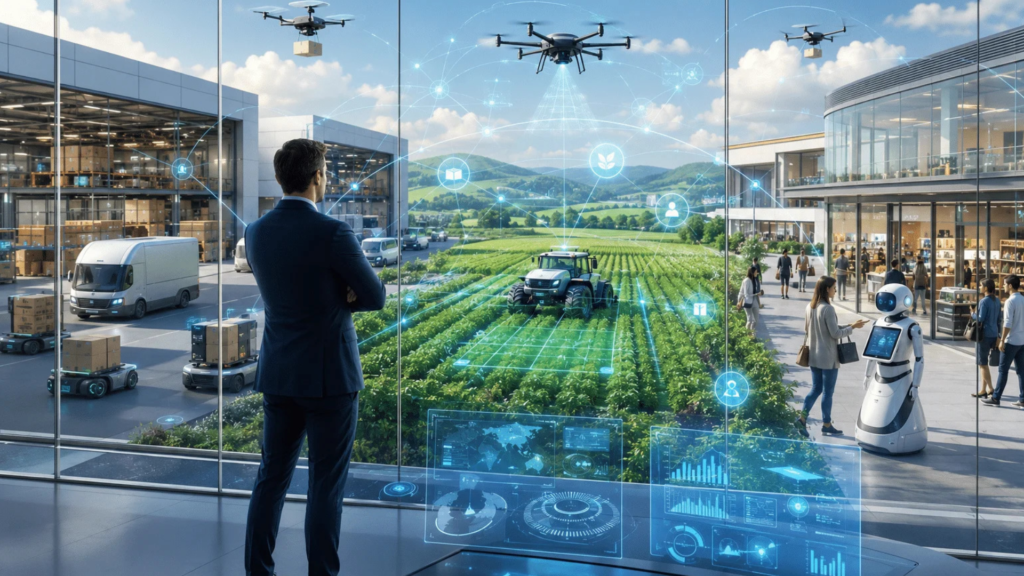
Autonomous systems have long been imagined on roads and in the skies. That image is becoming incomplete. The ability to make decisions and act with limited human intervention is moving into places beyond transportation. The U.S. National Institute of Standards and Technology (NIST) describes autonomous systems as technologies that combine robotics or automation with advanced algorithms to select and execute actions.
On farms, autonomy is beginning to change what happens between rows of crops. Agricultural robots can navigate fields, identify plants, and perform tasks such as planting, weeding, and harvesting. Using sensors, computer vision, and artificial intelligence, these machines can respond to changing field conditions rather than repeat predetermined movements. Machinery once operated by people is gradually becoming more adaptable.
The same shift is appearing in laboratories. Autonomous “self-driving” laboratories can select samples, determine how to characterize them, and use experimental results to decide next steps. Machines can handle repetitive processes while researchers concentrate on scientific creativity and interpretation. Autonomy therefore changes not only what machines do, but where human expertise is most valuable.
India is also exploring this wider role for autonomy. Government programmes are using drones, artificial intelligence, remote sensing, and connected technologies for crop monitoring and agricultural management. These applications show how autonomous capabilities can extend beyond transportation into rural settings and public services, where continuous monitoring and timely action can be valuable.
What makes this transition significant is not that machines can work independently. It is that autonomy is becoming useful in environments that are dynamic, uncertain, and difficult to reduce to fixed instructions. As these systems become more capable, people can devote greater attention to judgement, creativity, supervision, and accountability.
The rise of autonomous systems beyond transportation therefore represents more than the spread of smarter machines. It reflects a change in how work can be organized. From fields to laboratories and public services, autonomy is finding new roles wherever machines can take on repetitive tasks. Its future may be defined less by where machines travel and more by what they enable people to accomplish.
SOURCES:
- https://www.nist.gov/transportation
- https://www.nist.gov/programs-projects/development-standards-support-modular-and-autonomous-laboratory-ecosystem
- https://www.oecd.org/en/publications/progress-in-implementing-the-european-union-coordinated-plan-on-artificial-intelligence-volume-2_3ac96d41-en/full-report/ai-in-agriculture_c9ac6d24.html
- https://www.pib.gov.in/PressReleasePage.aspx?PRID=2297646&lang=2®=48