

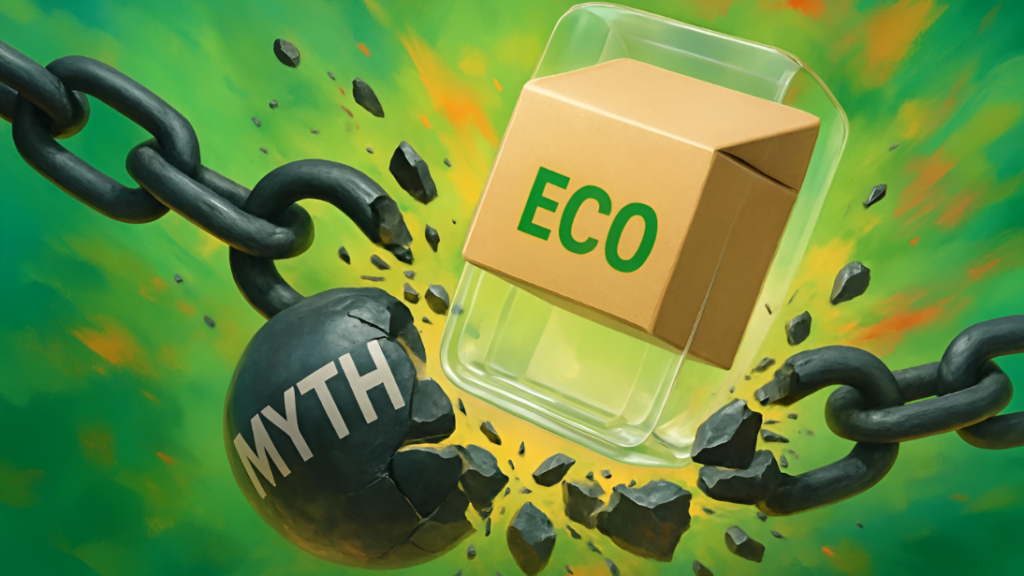
Packaging has become the public face of sustainability. From supermarket shelves to online deliveries, packaging increasingly carries environmental promises. Recyclable materials, biodegradable alternatives, and circular economy claims are now common. These labels suggest that sustainable packaging is becoming the norm. Yet for many industries, the reality remains far more complicated.
The appeal of sustainable packaging lies in what it represents: a way to reduce waste without significantly changing how products are made, sold, or consumed. However, the journey from a sustainability claim to a genuinely sustainable outcome is rarely straightforward. While many packages are technically recyclable, recycling often depends on collection systems, sorting facilities, and consumer participation that are not consistently available. As a result, large volumes of packaging still end up as waste despite carrying environmentally friendly labels.
The challenge becomes even greater when alternative materials enter the conversation. Compostable, biodegradable, and recycled-content packaging are often promoted as evidence of progress, creating the impression that sustainability has already been achieved. Yet these alternatives frequently face practical barriers, from disposal challenges to limited recovery systems. What appears sustainable in theory does not always deliver the expected environmental benefits in practice.
At the same time, widespread adoption remains difficult. Many businesses have announced ambitious packaging commitments around recyclability, circularity, and waste reduction, yet translating these goals into measurable results often proves far more challenging. Cost considerations, supply-chain realities, and performance requirements frequently slow progress, leaving a noticeable gap between packaging promises and everyday practice.
In India, the debate is growing as e-commerce, food delivery, and consumer goods markets expand. Policies promoting plastic waste management and Extended Producer Responsibility are encouraging improvement, but uneven recycling infrastructure and varying consumer awareness continue to limit outcomes in many regions.
Sustainable packaging is often presented as a straightforward answer to a complex environmental challenge. Yet for many industries, the gap between ambition and implementation remains significant, turning what is marketed as a solution into something closer to a myth than a reality. Real progress will depend on transparency, accountability, and measurable environmental results across the packaging value chain.
SOURCES:
- https://www.oecd.org/en/about/news/press-releases/2022/02/plastic-pollution-is-growing-relentlessly-as-waste-management-and-recycling-fall-short.html
- https://www.oecd.org/en/publications/2022/06/global-plastics-outlook_f065ef59.html
- https://www.pib.gov.in/PressReleasePage.aspx?PRID=1909909®=48&lang=2