

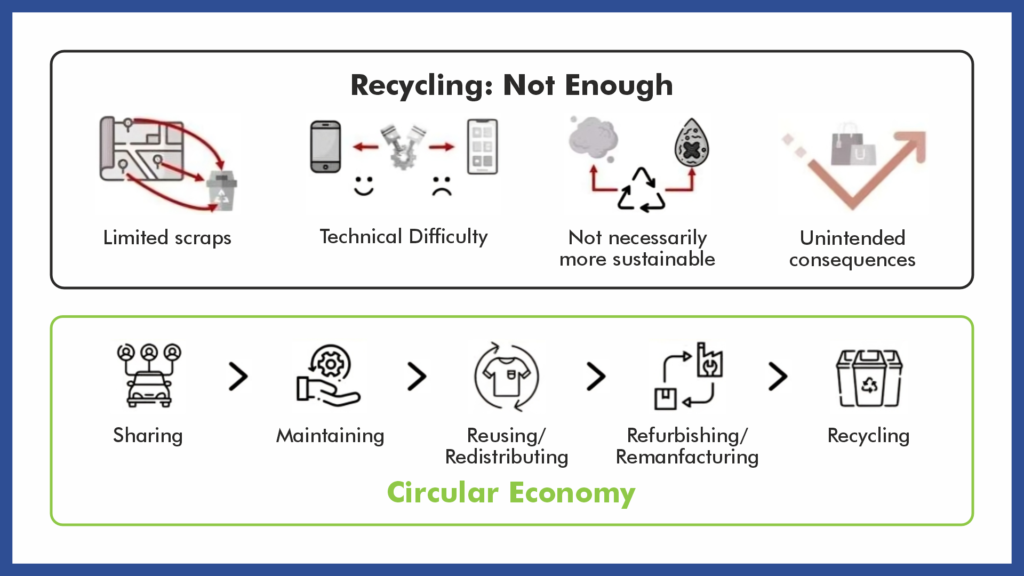
For decades, recycling has symbolized responsible consumption—a tangible act that reassures individuals they are contributing to environmental protection. Blue bins, sorting labels, and circular arrows have become embedded in everyday life. Yet, despite global efforts, the scale of waste generation continues to outpace recycling capacity. According to the Organisation for Economic Co-operation and Development (OECD), only about 9% of plastic waste is actually recycled worldwide. The rest is landfilled, incinerated, or leaks into ecosystems. Recycling, it seems, is no longer enough.
The challenge lies not only in waste management but in production systems themselves. Modern economies are still largely linear: extract, produce, consume, discard. Recycling intervenes at the end of this chain, but it does little to reduce the volume of materials entering it. The United Nations Environment Programme (UNEP) emphasizes that addressing pollution requires upstream solutions—rethinking design, reducing material use, and extending product lifecycles. This means prioritizing durability over disposability and shifting toward reuse-based systems.
A growing global response is the transition toward a circular economy. Unlike recycling, circularity focuses on eliminating waste at the design stage. Products are created to be repaired, remanufactured, or repurposed, keeping materials in use for as long as possible. Businesses are experimenting with refill models, product-as-a-service systems, and biodegradable alternatives. Consumers, too, are redefining value—favoring longevity, minimalism, and shared ownership over constant replacement.
In the Indian context, the conversation is evolving rapidly. India generates over 60 million tonnes of waste annually, with urbanization intensifying the challenge. While informal recycling networks remain strong, systemic gaps persist. Policies like Extended Producer Responsibility (EPR) are pushing companies to take accountability, yet behavioural change and infrastructure investment remain critical. Traditional practices—repair culture, reuse of materials, and low-waste living—offer valuable lessons for modern sustainability transitions.
The path forward demands more than better recycling—it requires a fundamental shift in how economies function. Reducing consumption, redesigning production, and rethinking value chains are no longer optional; they are essential. Recycling may remain part of the solution, but the future lies in preventing waste before it begins.
SOURCES:
- https://www.oecd.org/en/about/news/press-releases/2022/02/plastic-pollution-is-growing-relentlessly-as-waste-management-and-recycling-fall-short.html
- https://www.unep.org/topics/chemicals-and-pollution-action/plastic-pollution
- https://www.unep.org/resources/global-waste-management-outlook-2024
- https://www.pib.gov.in/PressReleaseIframePage.aspx?PRID=2104349®=3&lang=2
- https://www.teriin.org/article/towards-circular-plastics-economy-indias-actions-beatplasticpollution